PROS VS AMATEURS: Loving the boring
Amateurs think the grind is what matters. Pros find joy in daily repetition.
Hi team,
Things are looking a little different around here and I’m so, so psyched.
- New look newsletter - that’s what you’re reading! We’re disrupting the format to make things easier to read and implement. You can still read all the previous issues here.
- New newsletter name - Extra Reps, to reflect that the people who read this are already elite, and it’s the small extra reps we cover that help us become even more world-class.
- New look website - you're on it! (Thanks to the epic team at DreamLab)
What hasn’t changed? It’s free (and always will be). It’s monthly (no plans to clutter up your inbox). It’s written by me (never AI). And it’s still deep-dives that straddle sport and leadership. I want to share content that you can refer back to years from now and still find insightful.
I’m an athlete so I’m obsessed with feedback. Hit reply and let me know what you think.
- CJ
For 17 years, my Monday’s were the same.
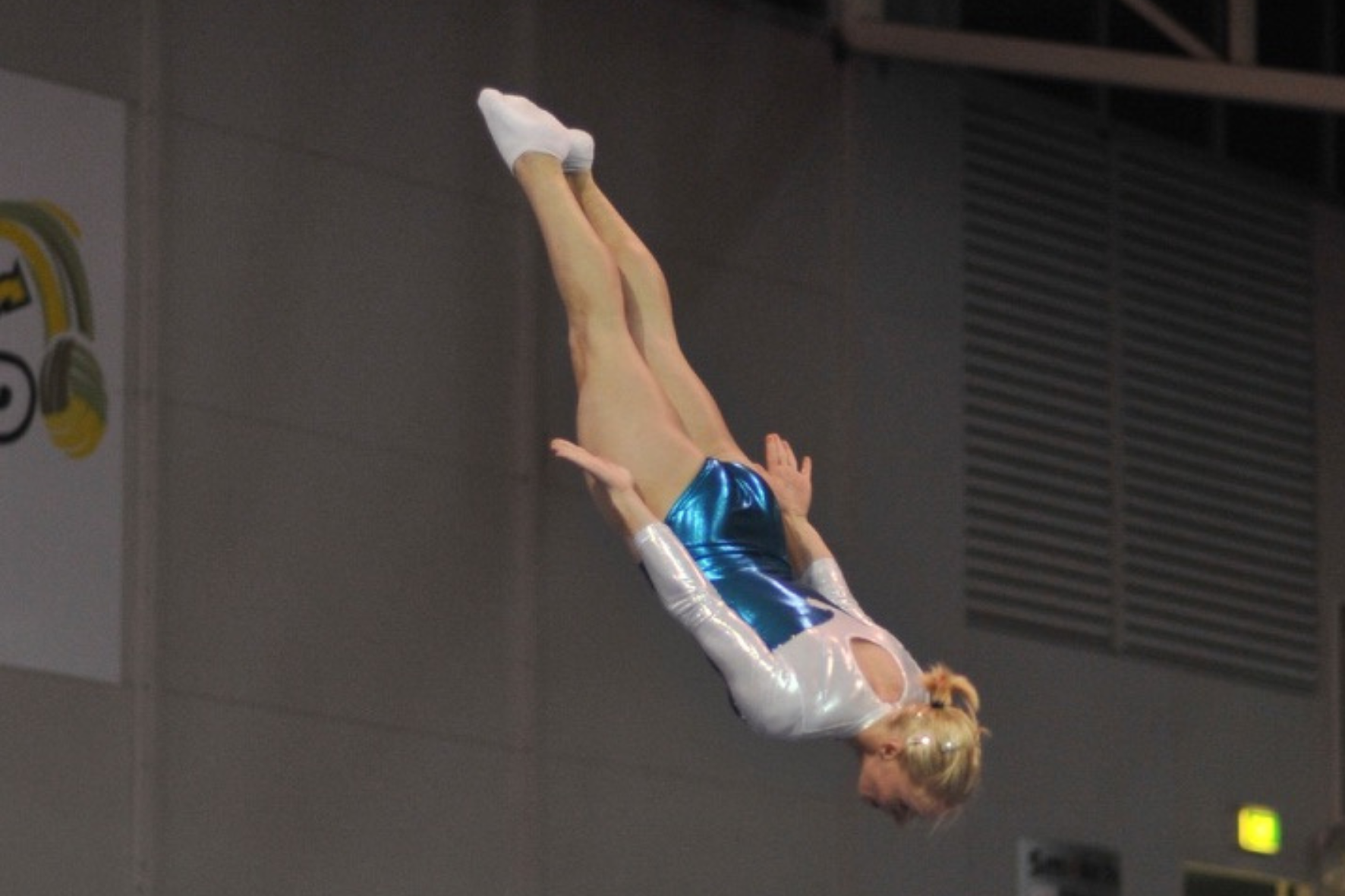
I would go to trampolining training.
Put on my leotard, and a pair of white socks.
And do the exact same drills.
Straight jumps, as high as I could.
Tuck, pike, and straddle. The basic shapes we teach 5 year olds.
Simple back somersaults. Aiming for perfect.
Easy baranis. A trick I'd already done 10,000 times.
It didn’t matter that I could do triple somersaults. Every single Monday was spent repeating the basics I had learnt as a child.
884 Mondays of the exact same thing.
And I loved it.
From 30 people to an arena of thousands. Audiences are on the edge of their seat, taking notes, and making changes before they leave the room.
Christie had me captivated from the minute she started speaking, her storytelling ability is potentially the best I’ve ever seen. I was in tears by the end of it, and spent the afternoon telling my 19 year old daughter everything you spoke about.
Sally Wagnon, HEXPO conference
Topics:
- Raising Standards
- Courage over Confidence
- Learning to Love the F Word (Feedback)
- Leading Innovation
- Investing in Women's Sport
I want CJ to speak at my event. Enquire now.

Why do basics matter?
When we start working on a new skill or profession, we assume that once we master the basics, we won’t have to revisit them. We’ll be onto the more exciting skills.
You’ll learn the correct footwork in tennis, and move on to hitting forehand winners.
Except Federer did basic footwork drills for decades. The kind with cones that most amateurs think they are too good for.
You’ll master the layout of a spreadsheet, and then it’ll all be about complicated new formulas.
Except the best analysts still build ever model from a blank page, and check every cell reference.
You’ll set the culture at your company, and make the right first hires. And then it’s on to more exciting strategy decisions.
Except Brian Chesky interviewed hundreds and hundreds of hires at AirBnb until the HR team staged an intervention.
The best athletes in the world know that the basics never stop. The best leaders do too.
"I read once that the true mark of a pro - at anything - is that he understands, loves, and is good at even the drudgery of his profession."
~ Paul Halmos, mathematician
The basics aren’t a separate skill you tick off. They're the foundation every other skill gets built on.
How to love the (boring) basics
It’s one thing to stick at the basics. I’ve written before about 6 strategies to stick at hard things.
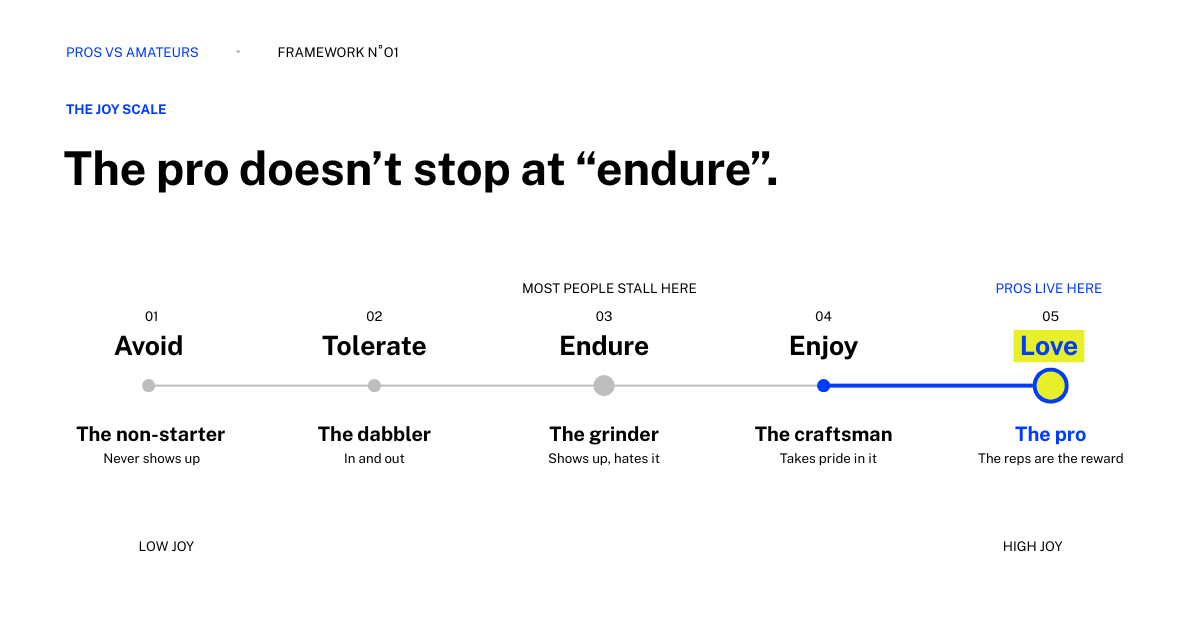
But real pros don’t just do the basics. They LOVE the basics. Where does that enjoyment come from?
2 things:
1. Mastery
It’s the sense of feeling effective and capable - like you’re good at something.
Self-determination research shows mastery is core to intrinsic motivation. And for our purposes, it’s core to finding enjoyment in the basics.
You’re meant to be good at them. Especially after 884 Mondays of doing the same thing! Remind yourself of your hard-earned mastery. It’ll help you feel the joy.
Kobe Bryant spends the first forty-five minutes of a workout on footwork drills school kids do. And he says: "I never get bored with the basics."
2. Progress
You’re not going to notice much progress on a basic skill that you are close to perfecting. That’s due to diminishing returns - where the better you get at something the more effort it takes to improve.
Instead, pros mentally link their work on the fundamentals to their progress on higher level skills.
- The 100 technique reps I did with the empty barbell -> contributes to a new PR lift.
- The revisiting I did to the basic sales script -> shows up in my team’s sales numbers
- The 884 Mondays of simple back somersaults -> when I learnt a triple back somersault my takeoff was perfect.
HBR research based on 1200 work based diary entries found that of all the things that happened on someone’s best day at work, progress was present 76% of the time.
More simply, Tony Robbins says ‘Progress = Happiness’.
To find joy in the basics, you just need to make the mental link to them being the foundation of all progress.
Simone Biles, after thousands of reps of the same skills: "There is a lot of fun along the way, but to make it to the top, you also really need to find joy in the work."
Pros don't grind through the boring parts to get to the good parts. The boring parts are the good parts.
That's the whole secret.
- Name your ‘basic’
What is a fundamental skill that your profession rests on? Communication, judgement, analysis, building relationships… or back somersaults?
- Slow down
This week, practise your basic slooooowly. This forces you to see shortcuts, errors, and ways to improve.
- Have someone watch you
Most people are hesitant to ask for - or give - feedback on something that should have been ‘mastered’ long ago. Ask a trusted peer to tell you how you could make it 1% better.
I retired from trampolining in my early 20s. I don't train for the sport anymore.
But every now and then, I get back on the trampoline.
And I’ll do straight bounces.
Simple shapes.
Easy back somersaults.
Dead centre, toes pointed, exactly the way I was taught at age five.
It's still my favourite thing.
Pros love the boring.
Ready for a speaker who
walks the Talk?
She runs, jumps, handstand walks, and backflips it too?
Join the
Newsletter
11k leaders raising their standards with monthly lessons from elite sport.