
“Nice hit!” said my beach volleyball partner for the day.
“Let’s run it again,” said our coach. “More angle this time.”
It was the first time I’d trained in the USA with a coach. I was a last-minute call-up to join someone else’s practice as her regular partner was sick.
It was going great.
Good chemistry.
We set each other up well.
Lots of high fives.
“5 more balls left,” said the coach. “Let’s make them all good ones.”
We’d started with a basket of forty balls, and now they were scattered all over the sand as my partner and I had hit them as hard as we could.
My partner added a little extra grunt as she hit the last ball at a crazy angle.
“So good!” I told her.
“Thanks,” she told me with a huge grin. “I love playing with you...” she paused. “Let’s shag?” she asked.
Whoa.
My brain came screeching to a halt. We were in the middle of practice, and she’d just propositioned me?
“Uhhh, what?” I asked.
“Let’s shag,” she repeated.
“Ummm, I love that you’re so open and forward,” I said. “I’m just… uhhh… ummm… not into girls.” I said.
“What?” now her face creased in confusion.
“Shagging?” I said. “I prefer guys.”
She laughed a little. “I meant let’s collect the balls,” and she pointed at all the beach volleyballs scattered across the beach.
“Oh…” I said. We looked at each other for a beat. And burst out laughing.
It was not the first time the Australian language had got me into trouble in the USA.
It’s a fun story, and as an Aussie every time I hear that word in the USA I laugh.
But the point is this:
Do the small things well.

Why does it matter?
Shagging the balls is a tiny action. But it’s one that says ‘I care about my equipment, I contribute to this team’.
And that message compounds into culture.
When we look at athletes from the outside, all we see is them playing their sport.
What you don’t see are the thousands of disciplined actions that surround their sport, which combine to make them elite.
- Shagging the beach volleyballs at the end of practice.
- Finding a gracious comment for the media.
- Thanking the coach after every practice.
- Encouraging a younger teammate.
- Staying late to pack up equipment.
- Prioritising sleep over a social life.
- Watching the extra hour of tape.
- Turning up early to do prehab.
- Helping coach set up the drill.
- Saying no to ‘just one drink’.
- Making time to meal prep.
- Cleaning our own gear.
What are the equivalent things in your career?
- Giving credit publicly.
- Doing an extra proofread.
- Arriving five minutes early.
- Writing the thank-you note.
- Replying to that email today.
- Remembering their coffee order.
- Learning (and using) people’s names.
- Doing the pre-read and making notes.
- Putting your phone away during meetings.
- Circling back to the person that introduced you.
- Noticing your team, and taking time to give feedback.
- Turning your camera on when everyone else has theirs off.
None of these are glamorous. None of them make the highlight reel. But stacked together, day after day, they are the difference between good and world-class.
Modelled for your team, they’re the difference between a leader who’s good at their job, and a leader people will follow anywhere.
The best leaders don’t just nail the big moments - the town halls, the keynotes, the crisis calls. They nail the small ones. They remember your name on your first day. They check in after a tough week. They don’t cancel the one-on-one. They ask a question and actually listen to the answer.
They carry their own bags.
Nobody writes a case study about a leader who always showed up on time. But everyone notices the one who didn’t.
There’s a beautiful story from the All Blacks about sweeping the sheds.
The All Blacks are the most successful team in the history of professional rugby. New Zealand’s national team draws from a country of fewer than five million people and they win - relentlessly - against nations many times their size.
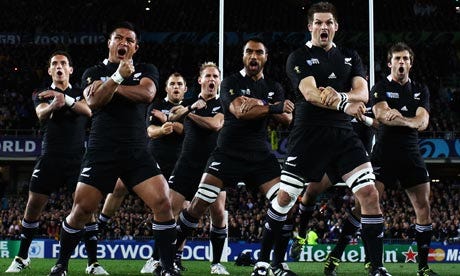
In James Kerr’s book Legacy, he tells the story of what happens after a match. While the stadium is still buzzing, while fans are still chanting, some of the most senior All Blacks - including former captain Richie McCaw, twice World Player of the Year - would quietly leave the celebrations and head back to the changing room.
Not to rest.
Not to ice their bodies.
To clean.
They’d pick up brooms and sweep the floor. They’d collect the used strapping tape, the gauze, the empty bottles. They’d leave the dressing room exactly as they found it - or better.
The cleaners would come in and say, “We can do that.” And the players would say, “No, we’ll do it.”
It wasn’t a punishment. It wasn’t a rostered duty.
The All Blacks created a culture that said: no one is too big for the small things.
The most capped, most decorated, most famous players in the squad were the ones holding the brooms.
One action to take after reading this:
Pick your ‘sheds’ or your ‘shagging’. Choose two or three small things in your work or life that you’ve been half-doing, skipping, or leaving for someone else.
Commit to doing them properly every single time for the next 30 days.
Not because anyone is watching. Because that’s who you want to be.
Culture starts with a broom.