
Trampolining was my first sport. For 17 years I did flips every day.
“Does it feel like flying?” I get asked.
And looking on, I can see why people ask that. I’m often 10 meters in the air, upside down, and - if I do my job right - making it look effortless.
The reality is less easy.
G-forces of 8.4G, more than an F1 driver or Air Force pilot.
Forcing your body to generate torque to do multiple twists mid-air.
Speeding up rotations by pulling your body into a tight tuck or pike, to make triple somersaults happen.
It’s physically demanding.
But even tougher… it’s scary as hell.
If you watched Simone Biles balk at doing her routines at the Tokyo Olympics, you may have heard the term ‘the twisties’.
Think of each skill in an athlete’s mind as following a single neural pathway. Double front with a 1.5 twist has a single set of neurons that light up to make the trick happen.
Double front with a 2.5 twist has another set of neurons that light up.
The twisties is when you take off to do the first trick and accidentally do the second. The beginning of each trick is so similar, that your neural pathways get mixed up.
Now imagine jumping on the trampoline 10 meters in the air, about to take off, and not knowing which trick you’re going to do.
Terrifying.
Scary.
‘The Twisties’ has happened multiple times in my career.
I’d get on the trampoline, start jumping, tell myself I was going to do the trick.
And then on takeoff just…
Stop.
In gymnastic sports we call it balking. Where fear overrides muscle memory. Where overthinking replaces confidence.
I was too scared to start.
And so my coach was faced with the problem: How do you teach bravery?

This is part 3 in a 5 part series. Read the first two posts here:
- World-first research on bravery. 7 findings that will overturn your beliefs
- Bravery > confidence: Don’t fear less, brave more
- Bravery is not a feeling, it’s a skill. 5 techniques to master it (this post)
- The only 3 questions you need to make brave choices
- I refuse to talk about impostor syndrome (and you should too)
The Courage Quotient
In post 1, we defined bravery as:
Bravery = Fear + Action
The most important thing to know is: ‘Fear’ and ‘action’ are independent variables.
No matter how much fear you feel, you can still act.
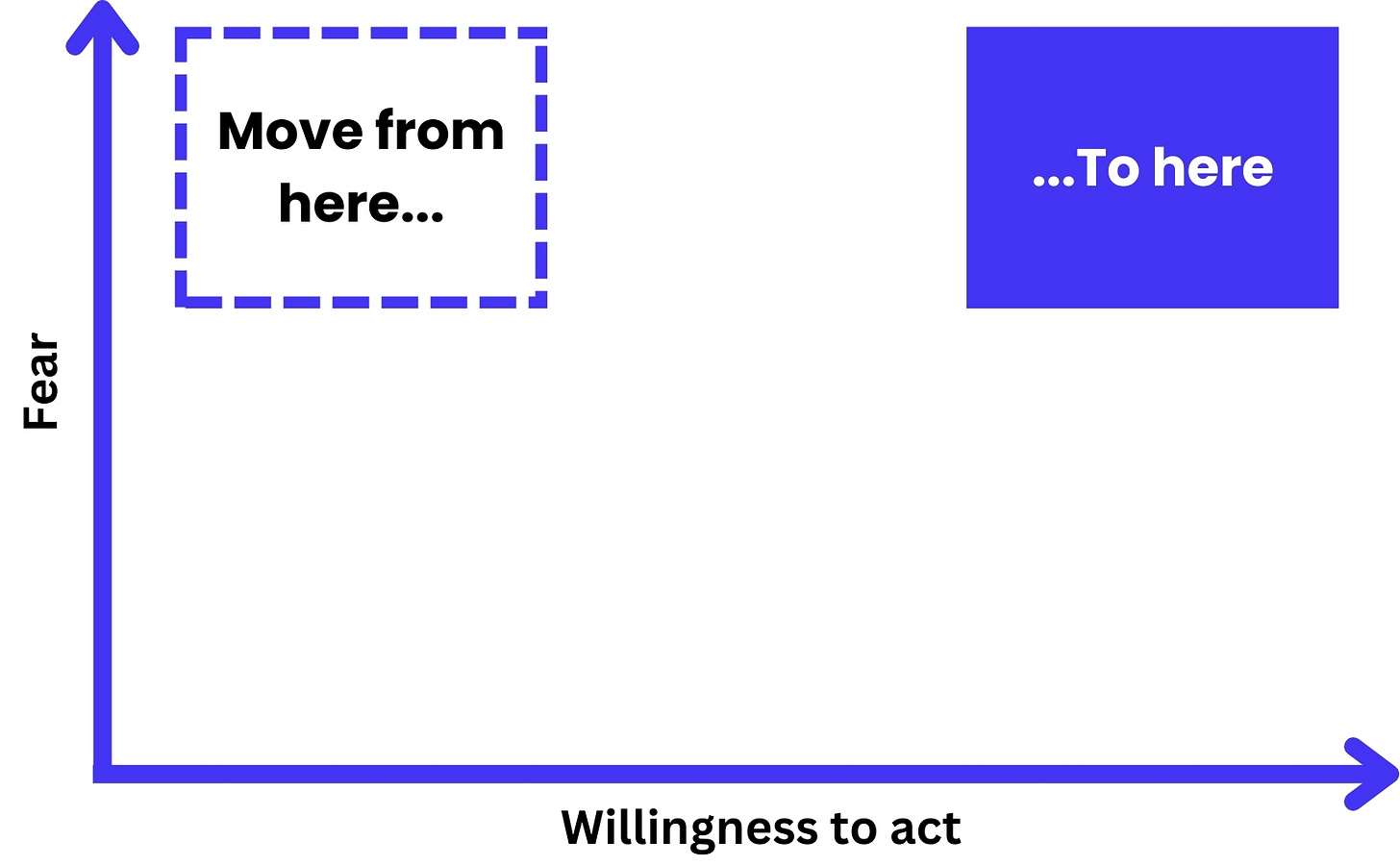
In post 2, we saw that the amount of fear we feel (and therefore the amount of courage we need) is influenced by two factors:
- The level of risk (more risk = more fear)
- Our level of skill (less skill and competence = more fear)
In my case of ‘the twisties’ my fear was exceptionally high.
And I couldn’t bring it down.
Not by reducing the risk. Trampolining is an inherently dangerous sport. One of my teammates was already a quadriplegic.
And not by increasing my competence. Technically, I could already do the skills. I was just too scared to take off.
I couldn’t change how much fear I felt.
But willingness to act? My coach taught me how to turn the dial up on this.
He taught me how to train bravery.
This is how.
5 science-backed ways to build bravery
1) Witness brave action
“Come over here?” said my coach.
“But that is the gymnasts side of the gym,” I said. We, as the trampolinists, had our own section.
“There’s something you need to see,” he told me.
Many trampolinists start in gymnastics and transition later. I never did. My mom knew I was going to be too tall for a sport where the average height is 5 feet.
And so when we walked over to watch the gymnasts training on the beam, I had never done a single trick on it. And honestly, I never wanted to. A beam is solid wood, and just 10 centimeters wide.
I’d take the trampoline any day.
“Watch,” said my coach. A solo athlete was on the beam, eyes focused. But she was rubbing her hands on her legs and I could see her toes clenching and unclenching with nerves.
“You’ve got this Annabel,” one of the gymnasts said.
“She took a bad fall on her layout last month,” whispered one of the other athletes in the group. “It’s always terrifying the first time trying it again after injury.”
Annabel looked over at her teammates…
… took a deep breath…
… and launched into a series of flips.
All on a 10 centimeter plank of wood.
The smile that lit up her face when she landed was huge.
Watching her be brave, inspired me to be brave.
To build bravery, witness other people doing brave things.
You can:
- Watch other people do something you fear
- Watch other people do something they fear
The science shows that both work.
“History has shown us that courage can be contagious and hope can take on a life of its own.” ~ Michelle Obama
2) Honesty with self
Fear has a tendency to expand.
I was scared of one trick on the trampoline.
But I started to doubt myself on other tricks.
And question whether I could even continue in the sport.
Fear wants to expand.
Especially if it stays in your head.
My coach brought in a sports psychologist to work with me.
“What are you scared of?” he jumped right into it.
“The half out trick,” I told him. “It’s a double front with a half twist.”
“Ok, that would scare me too!” he said. “But let’s get more clarity, which part of the trick is scary.”
“What do you mean? I can’t do the trick, I can’t even take off right now.”
“Well, are you scared of the tuck position,” he asked.
“No, of course not. I do that in dozens of other tricks,” I said
“Is it the landing? Are you worried that you might land wrong?”
“No, if I get through the trick in the air, I know the landing will be fine.”
“What about the takeoff?”
“No, this just requires physical strength and focus.”
It turns out, I was only scared of a tiny microsecond within the trick. The exact moment where there is a ‘blind spot’ in the skill as you flip upside down and twist at the same time.
Clarity matters. Generalised fear feels overwhelming. Specific fears feel actionable.
I could drill and visualise every part of the trick - except that tiny moment - without fear.
It made the fear smaller.
To build bravery, be honest about the specific thing you fear.
Only then can you make a plan to get through it with action.
Scared of going up to a stranger? Is it their reaction that you’re worried about or the people you know watching on?
Scared of speaking on stage? Is it that you’ll forget your words, the audience will laugh, or you’ll disappoint your mum? Which is the truly hard part?
Scared of calling someone out for discrimination? Are you worried about how they’ll react, or the consequences to your career, or the judgement from your peers?
“Vulnerability sounds like truth and feels like courage. Truth and courage aren’t always comfortable, but they’re never weakness.” ~ Brene Brown
3) Self reflection
“Get out your training diary,” my coach told me.
My training diaries are where I write exactly what I did - every trick, drill, and rep - for every single training session. I have 17 diaries. One for every year I did the sport.
“Here’s a highlighter,” he told me. “Go through your training diary and highlight every single time you did something difficult or scary this year.”
I looked back on over 200 sessions.
And I highlighted over 50 things.
It turns out, I was brave every single week.
So maybe I could be brave this week too.
To build bravery, reflect on the times you’ve done brave things.
“Self-reflection encourages great bravery. Rationalization is your greatest enemy.” ~ Awa Kenzo
4) Encouragement
I trained in a squad of 6 athletes.
That week I went back to basic drills. Takeoffs, single somersaults, positions in the air, doing skills into the foam pit.
Effectively, relearning the skill I was scared of from scratch.
The best part?
Every other athlete in my training squad did them with me. They didn’t have an issue with the trick, but they wanted to encourage me.
At the end of the week, the coach called me over to the trampoline and said:
“It’s time.”
“Now?” I asked. I hadn’t done the trick all week, and the fear was still a pit in my stomach.
“We’re all here to support you,” he told me.
And every athlete stopped their training. They walked over to the side of the trampoline. And they started cheering me on.
To build bravery, let others encourage you.
It might be the little push you need to start the scary thing. And starting is the hardest part.
“Surround yourself with only people who are going to lift you higher.” ~ Oprah Winfrey
5) Take brave action
Techniques 1 to 4 are all about increasing willingness to act.
Ultimately you still have to act.
Bravery = fear + action.
“Here’s the deal,” my coach told me. “You have to do 5 of the trick every training session.”
“5…?” I trailed off. Once felt terrifying. Five times felt overwhelming.
“Yes,” he was unyielding. “It will get easier the more often you are brave.”
To build bravery do brave things.
My coach threw in a bonus. Each day I hit all 5 attempts without balking, the entire squad got to pick a strength exercise to skip.
I wasn’t just being brave for me. It was for all of them too.
I didn’t miss a single day.
Like anything else in life, the more you practice being brave, the easier it becomes to take brave action.
“What you feel doesn’t matter in the end; it’s what you do that makes you brave.” ~ Andre Agassi
The advanced course: Training to run towards fear
Most of us don’t have truly dangerous jobs. We don’t have to run towards gunfire, or into collapsing buildings, or complete triple somersaults 10 meters in the air.
So the 5 strategies above are sufficient.
But if you want to get more advanced?
Now we get into neuroscience.
And the lesson from science is that fear is a cue - the same as any stimulus.
When we feel hunger, we eat.
When we feel happy, we smile.
When we see someone yawn, we yawn.
When we feel embarrassment, we blush.
When we are rejected by a friend, we feel hurt.
When we touch a hot stove, we pull our hand away.
The first part is a stimulus. The second part is our response.
When we feel fear, typically the response is fight, flight or freeze.
However, advanced practitioners of bravery know one truth, explained beautifully by Victor Frankl
“Between stimulus and response there is a space. In that space is our power to choose our response. In our response lies our growth and our freedom.” ~ Victor E Frankl
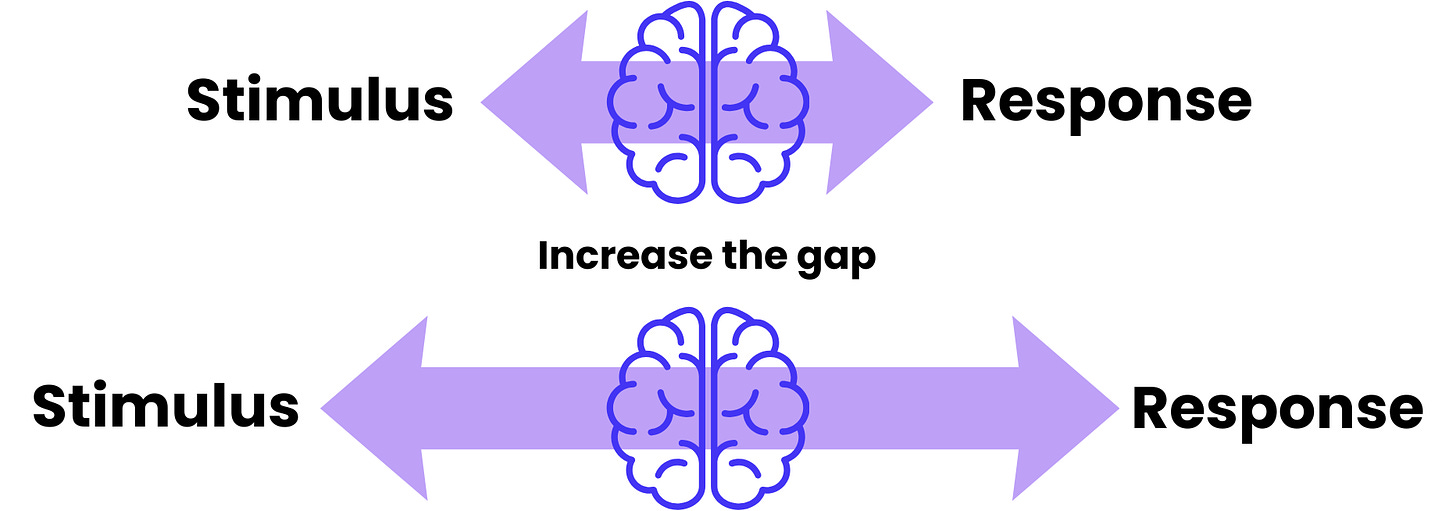
TLDR, you are not stuck with automatic fear reactions.
Here’s how to train yourself to run towards fear:
Step 1: Expand the ‘space’ between stimulus (fear) and response.
Step 2: Choose a new response. Lean into curiosity, calm, authenticity, or action.
Step 3: Repeat it with training. ‘Neurons that fire together wire together.’ With enough practice you can change the wiring of your brain to use fear as a signal to respond with curiosity or action.
This is how habits are built in every part of our lives. We change our wiring.
This is how to build a bravery habit.
“Build your bravery rather than wasting your time trying to reduce your fear. Fear is real. Fear is fuel. Fear is your damn cue for brave action.” ~ Crista Samaras
The ultimate goal: Bravery as an identity
“Are you a brave person?”
If you were asked this, what would your honest answer be?
If it’s not ‘yes’ today.
It can become ‘yes’ over time.
First, we develop bravery as a skill. Use the 5 techniques to increase willingness to act in the face of fear.
Second, we develop bravery as a habit. Choose a new response for when you feel the stimulus of fear, and rewire your brain with repetition until it becomes automatic.
Finally, we develop bravery as an identity. It becomes a foundational piece of our character that shapes decisions, career, relationships, and self-perception.
We go from, ‘I can do brave things’ to ‘I am a brave person.’
To do this only requires two things:
- Many many brave actions over time
- Self reflection on those actions, where you give yourself credit for being brave
The research on growth mindset proves that:
“The hand you’re dealt is just the starting point for development… Your basic qualities are things you can cultivate through your efforts. Although people may differ in every which way - in their initial talents and aptitudes, interests, or temperaments - everyone can change and grow through application and experience.” ~ Carol Dweck
The most powerful thing about building a brave identity is that when fear arises, we know we will choose courage.
Not because we have talked ourselves into it.
Not because we made it an automatic habit.
But because it is who we are.
“‘What keeps you up at night?’ A reporter once asked General James Mattis. ‘I keep people awake at night.’ he said.”
Final thoughts
The goal is not to eliminate fear. We can’t.
The goal is to increase our willingness to act.
First train the skill of bravery.
Then make bravery a habit.
Finally, create your identity as a brave person.
Make sure you are subscribed to get the final 2 blogs in this series:
- World-first research on bravery. 7 findings that will overturn your beliefs
- Bravery > confidence: Don’t fear less, brave more
- Bravery is not a feeling, it’s a skill. 5 techniques to master it (this post)
- The only 3 questions you need to make brave choices
- I refuse to talk about impostor syndrome (and you should too)