
‘I have imposter syndrome,’ the speaker on stage announced.
‘Raise your hand if you’ve also felt it’.
A sea of hands in the audience went up.
You’ve probably been in an audience like this.
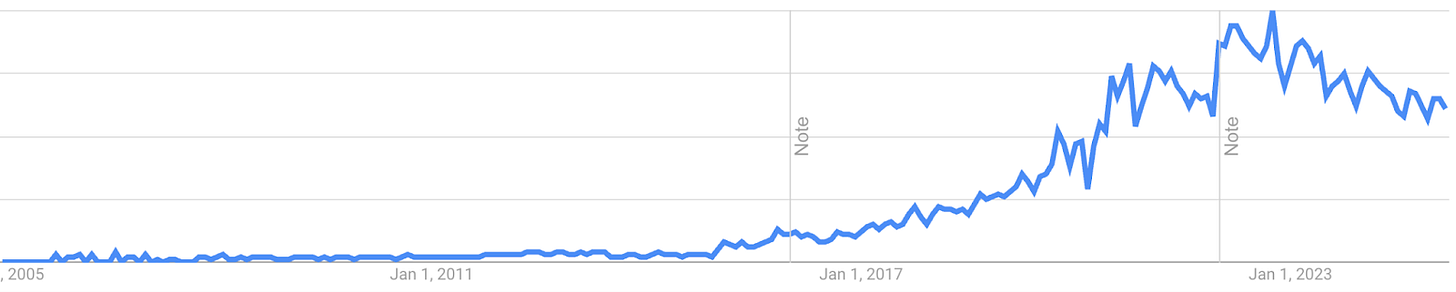
In fact, it seems like everyone, everywhere is talking about it. Here is the rise in the use of the term ‘imposter syndrome’ over the last 20 years from Google.
This is the final post in a 5 part series about Bravery. Read the first four posts here:
- World-first research on bravery. 7 findings that will overturn your beliefs
- Bravery > confidence: Don’t fear less, brave more
- Bravery is not a feeling, it’s a skill. 5 techniques to master it
- The only 3 questions you need to make brave choices
- I refuse to talk about impostor syndrome (and you should too) - this post
Is imposter syndrome real, or did we make it up?
Imposter syndrome is ‘the persistent inability to believe that one’s success is deserved or has been legitimately achieved as a result of one’s own efforts or skills’.
People describe it as feeling like a ‘phony’, that they ‘don’t belong’, or are ‘about to be found out’. That their success is not a result of their talent and skill, but due to luck, a special effort, or the misjudgement of someone assessing them.
The term was first used by researchers Pauline Rose Clance & Suzanne Imes in 1978. Yes, 1978.
But one we can’t seem to stop talking about.
‘Imposter syndrome is the term used to describe a feeling experienced by certain people, often women and ethnic minorities, when they are in positions of leadership or authority. They feel inadequate. They feel fraudulent. They feel like they don’t belong. In short, they feel like an imposter.’ ~ Caroline Criado Perez
The gap is fear. And fear is normal.
Put simply - anytime we perceive there to be a gap between what you think your abilities are, and what the external world thinks they are - we started using the term imposter syndrome.
We can feel that gap in plenty of places:
- Sitting in a board room and hesitating to speak up while everyone else seems so outspoken.
- Getting back good test results, and assuming you got lucky that the questions matched what you studied.
- Getting asked to speak on a panel, feeling nervous, and making the leap to thinking you’re underqualified and they just asked you to be there for the sake of diversity.
- Winning a medal, but it was on the day a strong competitor didn’t show up so it’s not as valid.

According to the world you are crushing it. You’re in the room, at the top of the class, on the stage, atop the podium.
But inside? You felt fear and doubt. And surely that invalidates your success.
‘If only people realised how hard it was for me to do that they wouldn’t be impressed,’ we think.
‘If only the people telling me how good I am were qualified to judge, I’d be found out,’ we worry.
News flash: It’s hard for everyone. We just don’t talk about it. And we don’t talk about it because we’ve made fear something to be ashamed of.
We created imposter syndrome by assuming that no one else feels fear with their achievements.
‘Another contributing factor to imposter syndrome is that you may not be aware that other people are experiencing it. The fact that others seem so confident, secure and full of self-esteem may reinforce your belief that your own doubts are proof of your illegitimacy.’ ~ Scott Young
In blog 2 in this series we spoke about how bravery is an undervalued virtue. We idolise confidence, instead of courage.
Bravery requires fear.
Most of us would choose to be fearless, rather than brave. We’d rather have confidence, than courage.
Perhaps because admitting we feel fear is shameful in our society. We admire fearlessness, above those who take action whilst feeling fear. We glorify achievements, arguing they are diminished if the person feels even a flicker of fear. We give accolades to heroes, and as we honour their acts we ignore that they must have felt doubt, uncertainty and fear.
You’ve felt happy before.
You’ve felt sad before.
You’ve felt excited before.
You’ve felt frustrated before.
We all feel these things at times, and we all talk about all of these emotions openly. No claims to have ‘happiness disorder’ or ‘sadness syndrome’.
Fear is different.
We all feel it. We just don’t admit to it.
And if the entire population experiences something it’s a normal emotion, not a syndrome.
TLDR, you’ll feel like an imposter sometimes (70% of people say they feel imposter syndrome). But that’s just fear, and fear is normal.
‘This is not to say that people don’t experience feelings of inadequacy in positions of authority. It’s not to say that leaders don’t feel like frauds, or, indeed, imposters. I know I feel that way on a daily basis. My quarrel is not with the “imposter” part of this so-called syndrome. It’s with the syndrome part. It’s with the implication that the problem with this feeling lies with the people experiencing it.’ ~ Caroline Criado Perez (edited to apply to both genders)
Talking about it adds to the problem
We made the term up. Then we talked about - all the damn time - until it became real to us.
We have told a generation of young people that it’s not normal to feel fear, doubt, uncertainty, or that you don’t belong. Instead we’ve doubled down on the message that if you feel those things, then you are the problem. You need to be fixed. You have a syndrome.
‘People don’t like it when I say that Imposter Syndrome doesn’t exist because they think I’m saying their feelings don’t exist. On the contrary. I know they’re real!’ ~ Amy Kean
Stop talking about imposter syndrome. Start talking about real skills to overcome fear.
Stop talking about lacking confidence. Start talking about seeking bravery.
Stop talking about feeling like you don’t belong in the room. Start speaking up anyway.
Eliminate the words ‘imposter syndrome’ from your vocabulary, and normalise talking about fear and bravery instead.
‘We should focus less on being perfect and more on being brave’ ~ Reshma Saujani
For the minorities (and female majority)... this term is disproportionately applied to us
It’s not that we don’t also use this term for men, but we disproportionately apply it to women and minorities. Why?
Two reasons:
1) We create terms to suppress the advancement of women
Take a tour through history and you’ll laugh - and be horrified - at how we’ve invented syndromes that diminish women.
- Ancient Egypt and Greek: Hysteria was the term used for ungovernably ‘emotional’ women. The cause was thought to be ‘a wandering womb’. And the best treatment a quick wedding and impregnation. (Later on midwives started manually stimulating orgasms as a treatment - quite and enjoyable visit to the doctor!)
- 1486: Witchcraft was a term revived by Heinrich Kramer, after a woman named Helena refused to attend one of his lectures. Feeling spurned, he penned the ‘most misogynistic book ever written’, accused her of witchcraft, and kicked off the murders of 40,000 women who were branded witches.
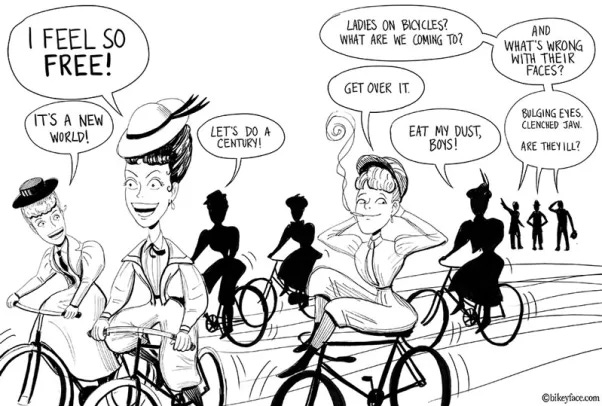
- 1890: Bicycle face was a medical diagnosis with the symptoms of ‘flushed cheeks, hard clenched jaw, bulging eyes, and an expression that is either anxious, irritable or at best stoney’. Many men took up bicycle riding too, but this condition was ‘strictly a women’s disease’. This disease just so happened to coincide with the rising feminist movement, where bicycles allowed female suffragists to organise between distant towns - without needing a ride from men.
What will we think of the term ‘impostor syndrome’ in 50 years?
2) It’s rational to feel like you don’t belong
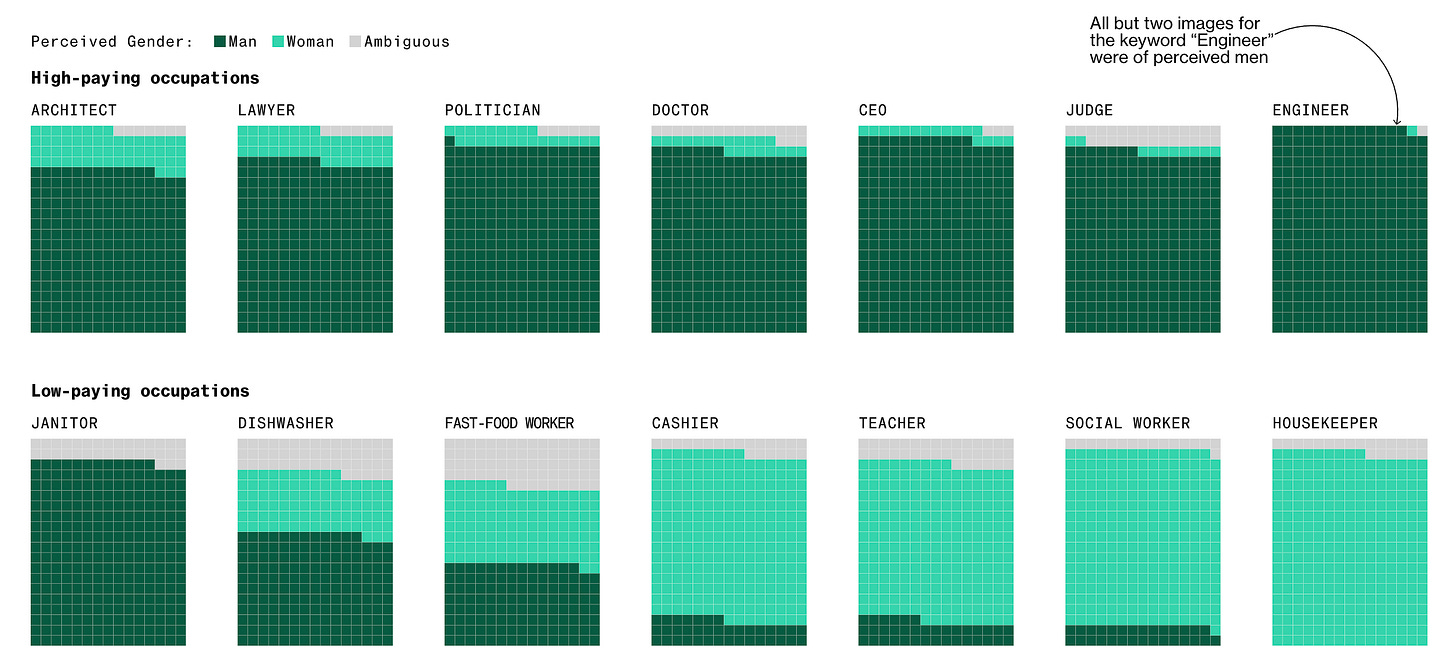
Ask kids to draw a picture of a banker, or a lawyer, or a CEO, and they almost always draw a man. Generate the images in AI and you get the same trend. We have been making slow and steady progress on female representation at all levels of business, and we finally have more women CEOs than CEO’s named ‘John’ in the largest 500 companies.
The truth is, even from a young age, we expect leaders, speakers, surgeons, and people in authority to be men.
As a woman in a position of power or achievement, it is rational to feel like you don’t belong because historically you haven’t.
AI mimics this: The chart above shows that when asked to generate an image of someone in a high-paying profession it overwhelmingly makes them male.
That feeling is not a problem with you. It’s a problem of history, systems, and institutions that haven’t put women in equal positions for thousands of years.
‘There is nothing wrong with you. You do not have a syndrome. You are not irrational. Rather, you are responding very rationally to a culture in which to be in a position of authority while female is to be an imposter — a culture which will, as a result, disproportionately penalise you when you are anything less than perfect.’ ~ Caroline Criado Perez
5 things I’m doing instead of talking about Imposter Syndrome
1) Remembering everyone else is scared too
Just like social media is the highlight reel of people’s lives, when you see people act confident you are only seeing the outside.
You missed their inner monologue where they had to psych themselves up. You missed how they chastised themselves for a misspoken sentence later that night. You missed all the things they wanted to do but were too scared to tackle and never spoke about.
This stems from the availability heuristic where we can recall more instances of people being confident and outspoken, and therefore assume that everyone is like that. It’s similar to how college students overestimate how much drinking and sex their peers are having - simply because the people doing those activities are highly visible (like confident people) whereas the people studying in the library are not.
You’re scared on the inside, and so is everyone else. I’m going to remember that.
‘The world is run by insecure overachievers. I used to think my insecurity was a downfall and I would just hide it and try to pretend it’s not there. And then someone that I really look up to told me that [they feel it too], and I’m like, okay, so I’m not the only one.’ ~ Meltem Kuran Berkowitz, head of growth at Deel, which went from $0 to $300m in ARR in three years (the fastest company in history to do so)
‘If you could enter into the private lives of many successful people, and see how they struggle with their insecurities or worries that they may have reached levels of success exceeding their merit, you’d probably be reassured that your own feelings are normal. Yet confident people are highly visible, those who struggle with doubts keep their mouths shut.’ ~ Scott Young
2) Normalising fear, celebrating bravery
I’m not giving anymore airtime to imposter syndrome. Instead, when I have the microphone I want to celebrate people’s actions in the face of doubt and dissidents, and the big swings they took regardless of how it worked out.
It’s a lot more productive to talk openly about fear and ways to overcome it, than it is to give airtime to ‘imposter syndrome’.
Let’s share fears, and let’s celebrate bravery. Regardless of the outcome.
‘Most of our businesses do succeed, but if something completely fails, then as long as we bow out gracefully and pay off all our debts, and nobody gets hurt, then I don’t think people disrespect Virgin for trying. The public appreciates someone having a go; it appreciates the attempt.’ ~ Richard Branson (read the blog on the week I spent with him here)
3) Looking backwards, not only forwards
I have an extreme future orientation. Tick one goal off, I barely celebrate before moving onto the next. That’s a useful trait for progress.
But each time I reach a milestone, I re-baseline my goals to the people ahead of me. Qualify for World Championships, now I want to make the final. Make the final, next time I want a medal. Get a medal, I wish it was gold. Win gold, compare myself to the athlete who won it 3 years in a row.
I’m constantly comparing myself to the goals ahead of me, and measuring how far I have to go.
What if I turned around and looked at the goals that are behind me, and measure how far I’ve already come?
Look backwards at our successes, not just forward at our goals.

‘There’s nothing wrong with setting harder goals. The problem with impostor syndrome is that you erase your own past progress by changing your standards to put it “below” what you consider successful.’ ~ Scott Young (he wrote a great post on this concept here)
4) Owning achievements
‘How do you overcome imposter syndrome,’ is what a journalist asked Olympic Bronze medalist and rugby player Ilona Maher after the Paris Games.
‘I don’t have that,’ she replies.
‘Really?’ the journalist doubles down.
‘No, I don’t know what that is. It’s like you don’t feel like you deserve it?’
‘Yeah…’
‘No, I don’t think I have it.’
‘Wait, how is that possible? I feel like imposter syndrome ruins my life sometimes.’
Ilona takes a moment and then delivers this banger:
‘I feel like I deserve what I’ve gotten. I think that I’ve worked very hard, even in the rugby space. I’ve played sports my whole life… and then I do all the work off the field. I posted videos consistently from Tokyo til now. I posted many videos a day. I put myself out there . I put my whole personality my whole everything out there.’
Full clip here.
Own our achievements. Don’t brag, don’t be overly humble, just be matter of fact. Think: ‘I did this, I worked hard to be here.’
‘It’s ok to be proud of what you’ve done. It’s ok to believe you deserve something because you’ve put in the work for it.’ ~ Ilona Maher

5) Keep a ‘keepers’ file
The human brain is hardwired for negativity - it was an evolutionary mechanism to help safeguard us from being outcast from the tribe.
In modern times, most of us have experienced a glowing performance review, and yet we will go home, eat a tub of ice cream and stress for 3 hours about the one mildly negative, offhand comment our boss made.
It’s hard to change your hardwiring, but the next time you feel doubt or fear creeping in, re-read your ‘keeper’ file. Trust me, it’ll never get old.
Things that belong in a keeper file:
- A wildly good testimonial
- Appreciation text from your friend
- A note of thanks from a team member
- An achievement you’re deeply proud of
- Screenshot of congratulatory comments on a social media post
- A memory of a time you did the hard thing that was the right thing to do.
If it made you feel positive, it goes in the keeper file. It’s the best antidote to feeling like an imposter.
“Our brain is like Velcro for bad experiences and like Teflon for good ones. We tend to hold on to criticism far longer than we cherish praise, letting a single negative moment overshadow a host of positive ones.” ~ Rick Hanson, PHD
Final thoughts
Imposter syndrome is a myth.
We made it up. Then we talked about - all the damn time - until it became real to us.
I’m done talking about it. I hope you are too.
‘Imposter Syndrome isn’t something you have, it’s something you’re given. Babies are born with two fears: a fear of loud noises and a fear of falling. None of us are born believing we’re not good enough. Those voices in your head are the result of bullies, toxic work cultures, insecure colleagues, being called bossy, too loud, too much, being interrupted, receiving unsolicited feedback, being told you’re progressing too fast or thinking too slow.’ ~ Amy Kean
Fear is normal. Doubt is normal. Feeling like you don’t always belong is normal.
We don’t need to label it a syndrome. Instead we need to remember that bravery is fear plus action. If it wasn’t hard, if it wasn’t scary… was it even worth going after?
Let’s stop self-diagnosing ourselves with imposter syndrome. And let’s step into bravery.
here’s the truth,
whispered between heartbeats
and half-lit moons:
you are not too much.
you are not broken, you are blooming.
you are not a tangled mess of desire and doubt—
you are the whole damn garden.
and somewhere along the way,
they told you to keep your voice down,
to button up your body,
to color inside the lines of what love, lust, and life
should look like.
they told you to shrink.
but the truth?
you were never meant to fit
inside their boxes.
~Christopher Sexton
This is the final post in a 5 part series on Bravery. You can read them all here:
- World-first research on bravery. 7 findings that will overturn your beliefs
- Bravery > confidence: Don’t fear less, brave more
- Bravery is not a feeling, it’s a skill. 5 techniques to master it
- The only 3 questions you need to make brave choices
- I refuse to talk about impostor syndrome (and you should too) - this post